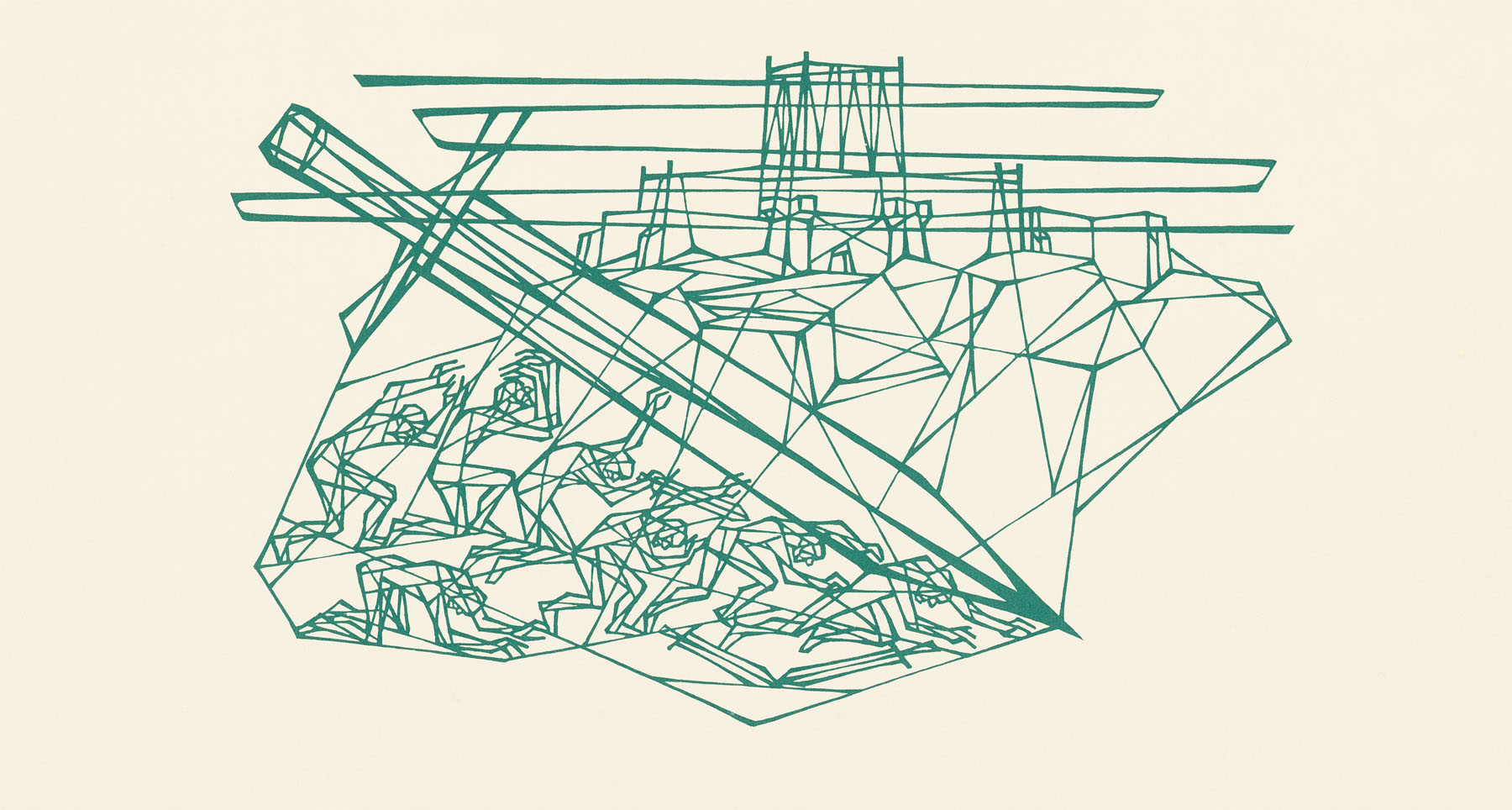
Drawing by Ismar David from The Psalms: A new English translation, linked with permission from Ismar David Archive .
For other images of Ismar David drawings, see here.

תְּ֭רֹעֵם בְּשֵׁ֣בֶט בַּרְזֶ֑ל כִּכְלִ֖י יוֹצֵ֣ר תְּנַפְּצֵֽם׃
9You shall break them with a rod of iron
and dash them in pieces like a potter’s vessel.”
Drawing by Ismar David from The Psalms: A new English translation, linked with permission from Ismar David Archive .
For other images of Ismar David drawings, see here.
You shall break them … and dash them in pieces: both statements describe how the king of Israel will defeat and destroy the Gentile nations. The second verb implies a more thorough destruction than the first one; so Good News Translation “break” and “shatter … in pieces.” One of the most common techniques to achieve intensification in biblical parallelism is the use of the simile in the second clause. The intensification of poetic effect is made here also by the contrast of breaking with an iron rod and the shattering of a fragile clay pot. The translator’s ability to maintain the degree of contrast will depend on the verbs used and the existence of clay pots, well known for their tendency to be easily smashed. It may not be natural to use this figurative language, and so the following may be better: “You will defeat (or, subdue) them … you will destroy them completely.” The verb in line a of the Masoretic text is “break”; but the same consonants of the Masoretic text, with different vowels, which are given in the margin of the text, mean “to rule,” and this is how the Septuagint, Syriac, and Vulgate translate it (also New American Bible, New International Version, and Bible en français courant). And this is the form also in which the text is used in Revelation 2.27; 12.5; 19.15.
A rod of iron is a figure of the ruthless power the king will use to defeat the pagan nations (New Jerusalem Bible “with an iron mace”). In some languages it is unnatural to speak of “breaking” nations with an instrument. Other figures of speech which are natural in the language may be found which will symbolize despotic rule; for example, “to trample with the feet” or “to strike with the fist.”
A potter’s vessel: “pottery” (New International Version), “a clay pot” (Good News Translation, New English Bible), “pots” (New Jerusalem Bible). This was easily broken and could not be put back together. Here it is a figure of complete and permanent destruction.
In most areas of the world, potter’s vessel can be translated as a “clay pot.” However, where clay pots are not made and known, a substitute, breakable article of local manufacture may be used.
Quoted with permission from Bratcher, Robert G. and Reyburn, William D. A Handbook on the Book of Psalms. (UBS Helps for Translators). New York: UBS, 1991. For this and other handbooks for translators see here .
The following is a presentation by the Psalms: Layer by Layer project, run by Scriptura .
Copyright © 2023, Scriptura.
No comments yet.
Leave a Reply
You must be logged in to post a comment.