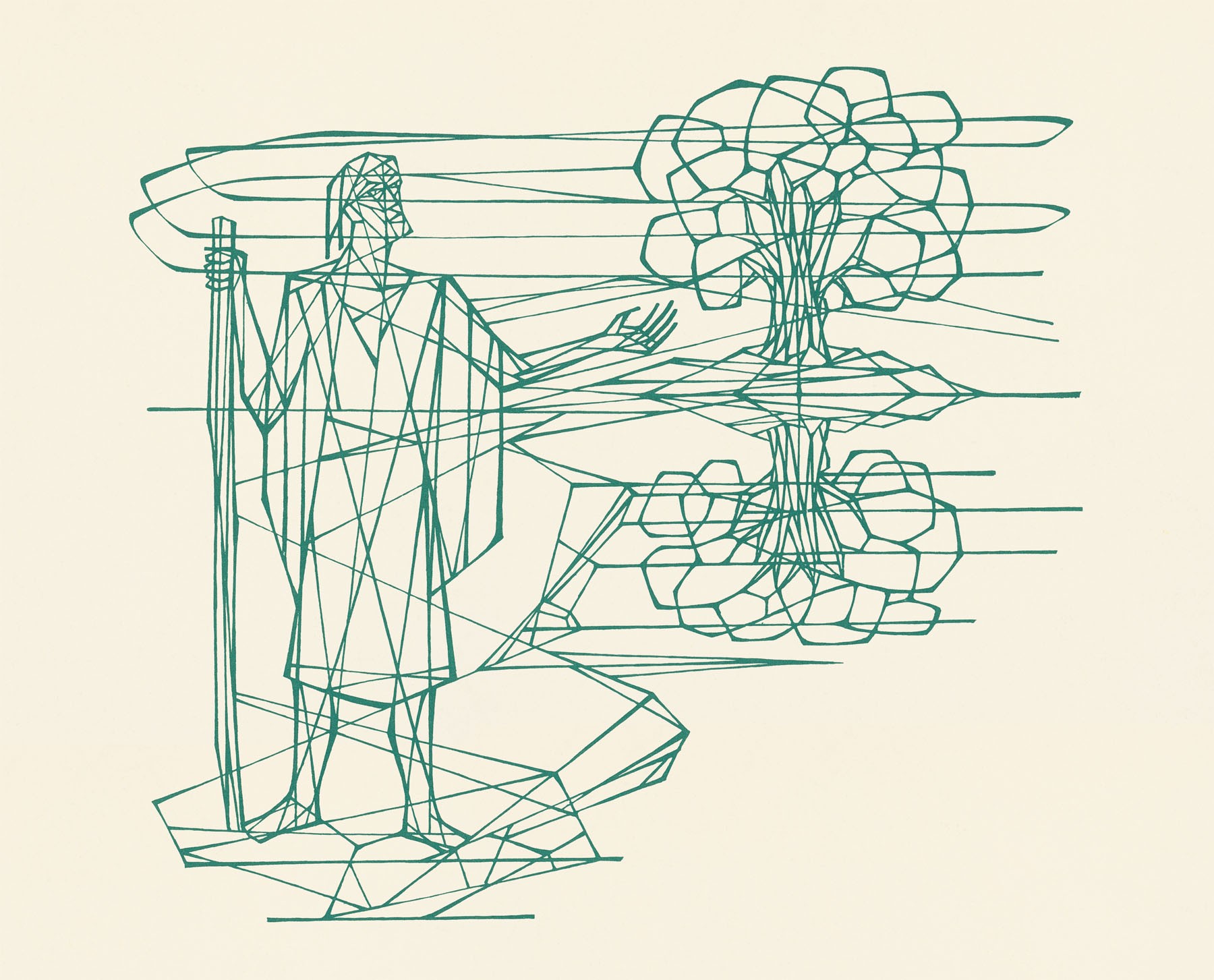
Drawing by Ismar David from The Psalms: A new English translation, linked with permission from Ismar David Archive .
For other images of Ismar David drawings, see here.

וְֽהָיָ֗ה כְּעֵץ֮ שָׁת֪וּל עַֽל־פַּלְגֵ֫י מָ֥יִם אֲשֶׁ֤ר פִּרְי֨וֹ ׀ יִתֵּ֬ן בְּעִתּ֗וֹ וְעָלֵ֥הוּ לֹֽא־יִבּ֑וֹל וְכֹ֖ל אֲשֶׁר־יַעֲשֶׂ֣ה יַצְלִֽיחַ׃
3They are like trees
planted by streams of water,
which yield their fruit in its season,
and their leaves do not wither.
In all that they do, they prosper.
Drawing by Ismar David from The Psalms: A new English translation, linked with permission from Ismar David Archive .
For other images of Ismar David drawings, see here.
Following are a number of back-translations as well as a sample translation for translators of Psalm 1:3:
This verse is remarkably like Jeremiah 17.8; see also Psalm 92.12-14.
The righteous are compared to healthy trees, provided with abundant water, which “bear fruit at the right time” (Good News Translation), that is, at the proper season of the year.
The verb planted is taken by some commentators to mean “transplanted” (see Ezek 17.8, 10, 22; 19.10, 13); most translations have simply “planted,” since the important thing is not whether the tree is planted or transplanted, but that it grows where there is plenty of water.
Streams of water: a literal translation of the Hebrew phrase, which means either a natural course of water or an artificial canal. In either case it supplies fresh running water to the tree. However, the picture of fruit trees growing beside a water course in the dry Middle East is quite different from that of trees growing along low-lying or swampy stream beds in the tropics. In the tropics fruit trees are often grown away from streams, since they require better drainage. Accordingly they depend on the rains for their water, and a desirable rendering may be “They are like trees that grow where there is plenty of water” or “They are like trees that grow well because they are well watered.”
Season may often be rendered as in Good News Translation, “at the right time,” or “always,” or in some languages “without ever failing.”
Its leaf does not wither: “its leaves don’t wither.” The withering of leaves is an indication that the tree is dying, or dead, and so in some languages it may be more effective to say “it does not die” or “it stays strong and healthy.”
In all that he does, he prospers: see Joshua 1.8b. Some think that a tree is the subject of this last line (see American Translation [An American Translation] “and whatever it bears comes to maturity”; see also New Jerusalem Bible). But most commentaries and translations take the righteous person to be the subject; so Good News Translation “They succeed.” The verb “to prosper” includes all areas of life, not only spiritual but also financial and physical.
If translators keep the plural subject, as in Good News Translation, they must make certain that the pronoun refers to the persons compared to the trees, and not to the trees themselves. In some cases it will be best to introduce a new subject; for example, “People who follow God’s way.” Prospers is translated in some languages by means of idiomatic expressions; positively it may sometimes be said “People who follow God’s way will see goodness” or “… will touch good things,” or negatively, “… will not fail to see good things.”
Quoted with permission from Bratcher, Robert G. and Reyburn, William D. A Handbook on the Book of Psalms. (UBS Helps for Translators). New York: UBS, 1991. For this and other handbooks for translators see here .
No comments yet.
Leave a Reply
You must be logged in to post a comment.